
Branding First, Ads Second: Why Your Ad Budget Might Be Going to Waste
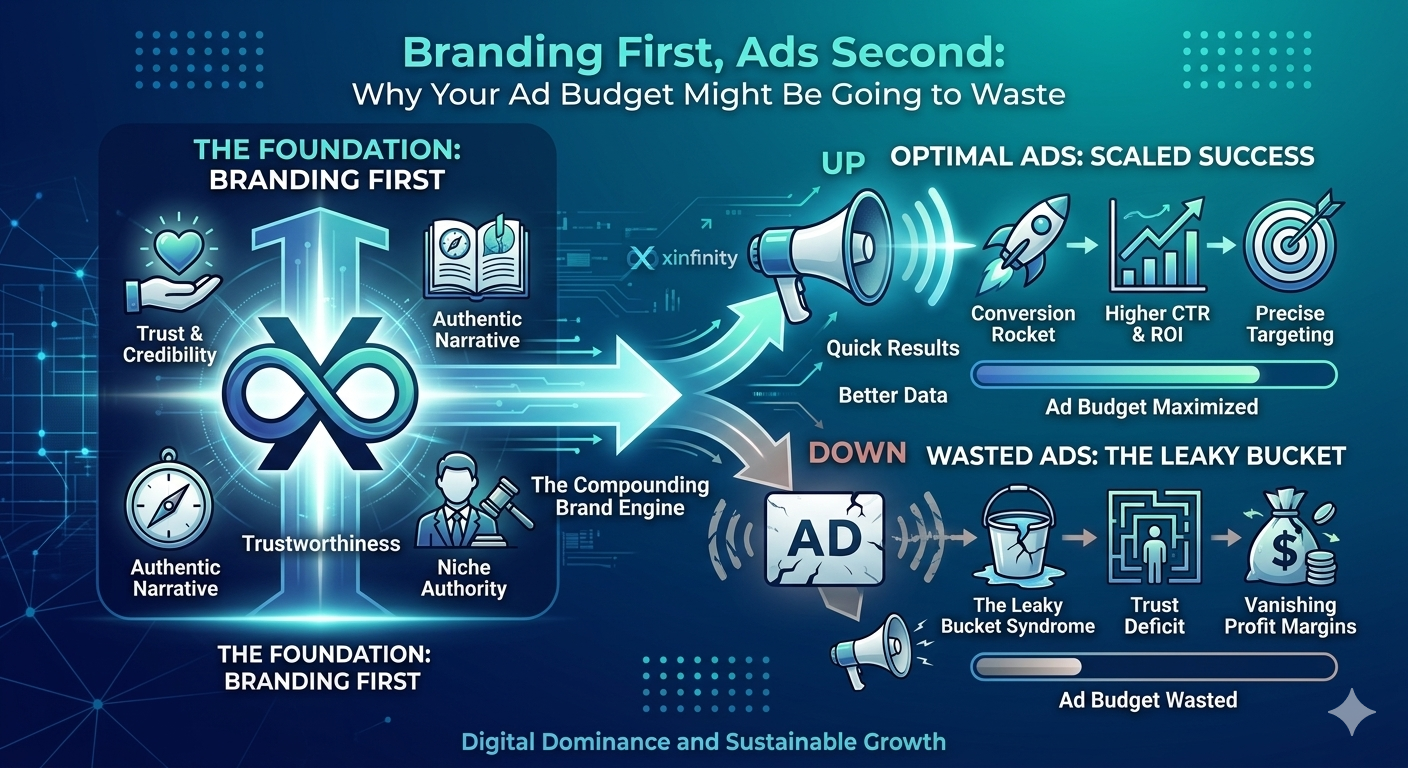
In the hyper-competitive digital marketplace of 2026, many business owners fall into a costly trap: they believe that throwing money at Meta, Google, or TikTok ads will automatically result in sustainable growth. They treat advertising as a “magic wand” rather than a megaphone.
At Xinfinity, we operate by a different creed: Branding First, Ads Second. If you amplify a weak brand with a massive ad budget, you aren’t scaling your success—you are simply scaling your failure. Here is why paid campaigns fail when the brand foundation is shaky, and how to fix it.
1. The “Magnification” Effect of Advertising
Advertising is a megaphone. If you have a clear, compelling, and trustworthy message, the megaphone helps you reach thousands. However, if your message is confusing, your visual identity is dated, or your value proposition is unclear, the megaphone only tells more people that your brand isn’t worth their time.
Ads bring people to the door; Branding invites them in and makes them stay.
2. The Trust Deficit
In an era of deepfakes and AI-generated spam, consumers are more skeptical than ever. When a user clicks an ad and lands on a website that feels generic or disconnected from the ad’s promise, a “trust gap” is created.
-
Without a strong brand: You are a stranger asking for money.
-
With a strong brand: You are a recognized authority solving a problem.
Paid ads can buy “Attention,” but only a strong brand can earn “Trust.” High conversion rates are almost always a result of pre-existing brand equity.
3. The Rising Cost of “Cold” Traffic
The cost-per-click (CPC) on major platforms continues to rise. If you are relying solely on ads to introduce yourself to a cold audience, your profit margins will eventually vanish.
A “Branding First” approach focuses on Brand Recall. When people recognize your logo, your colors, and your “voice” (like the cinematic storytelling we prioritize at Xinfinity), your click-through rates (CTR) go up, and your costs go down. Algorithms favor brands that users actually interact with.
4. Direct Response vs. Emotional Connection
Ads are usually “Direct Response”—they ask for a click, a sign-up, or a purchase. They are transactional. Branding is emotional. It’s the “Numou” (growth) of a relationship between the company and the customer. If your ads are the only time people hear from you, you have a transaction, not a customer. Strong branding ensures that even when you aren’t running ads, your audience is still thinking about you.
5. The “Leaky Bucket” Syndrome
Imagine pouring expensive water (Paid Ads) into a leaky bucket (a weak brand/website). No matter how fast you pour, the bucket will never stay full.
-
The Leaks: Inconsistent messaging, poor visual direction, lack of social proof, and a generic “vibe.”
-
The Fix: Patch the leaks by defining your brand identity and storytelling before you spend a single dollar on a “Boost” button.
How to Build the Foundation
To ensure your next campaign doesn’t just “reach” people but actually “converts” them, ask yourself these three questions:
-
Identity: If my logo was removed from my ad, would people still know it was me?
-
Authority: Does my digital presence (website/social media) look like a leader in my industry?
-
Story: Am I selling a product, or am I inviting the customer into a better version of their own story?
The Xinfinity Way
At Xinfinity Advertising, we don’t just launch campaigns; we build legacies. We believe that professional marketing advice for startups should always begin with the Identity. By integrating AI-assisted creative direction with high-level brand strategy, we ensure that when you finally press “Start” on your ads, the world sees a brand that is ready to lead.
Don’t spend more on ads. Invest more in who you are. Branding First. Ads Second. Success Always.

Leave a Reply